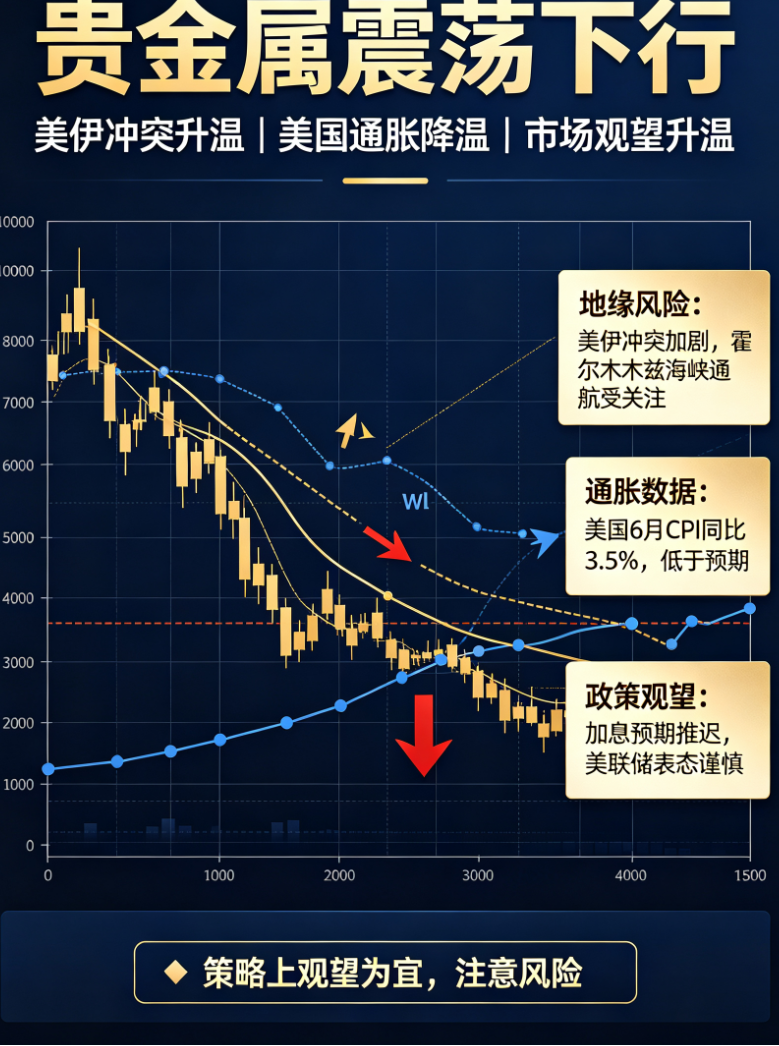
Asset Pricing Logic Restructuring Under Geopolitical Games: US-Iran Conflict, Oil Crisis, and Gold Volatility
Abstract
Recently, the US-Iran conflict has continued to escalate, causing turmoil in the global energy market. CICC Futures pointed out that overseas institutions are concerned that global strategic petroleum reserves and other "buffers" are nearly exhausted, and fear of extreme supply crises is spreading. Based on this background, this article deeply analyzes the potential impact of the US-Iran conflict on crude oil and refined oil markets, systematically evaluates the mechanism of oil price changes on gold prices, and combined with the global macro environment and geopolitical situation, makes a prudent prediction of short-term gold trends. Research shows that although rising oil prices may boost gold's safe-haven demand in the short term, there are multiple constraints on the transmission path between the two, and gold will remain in a volatile pattern. Investors need to be wary of nonlinear risks brought by geopolitical "black swan" events.
1. Introduction
Since the summer of 2026, the geopolitical landscape in the Middle East has become tense again. Conflicts between the US and Iran over nuclear issues, military deployments, and regional proxy conflicts have become increasingly heated. The latest report from CICC Futures reveals an alarming fact: global strategic petroleum reserves—the core mechanism that has acted as a "buffer" during past supply shocks—may be nearly depleted. If the Strait of Hormuz is blocked or Iranian oil facilities are attacked, global crude oil supply could drop by millions of barrels per day, while OPEC+ spare capacity is also stretched thin. Against this backdrop, Brent crude prices once broke through $95 per barrel, WTI crude followed, and the market panic index rose simultaneously.
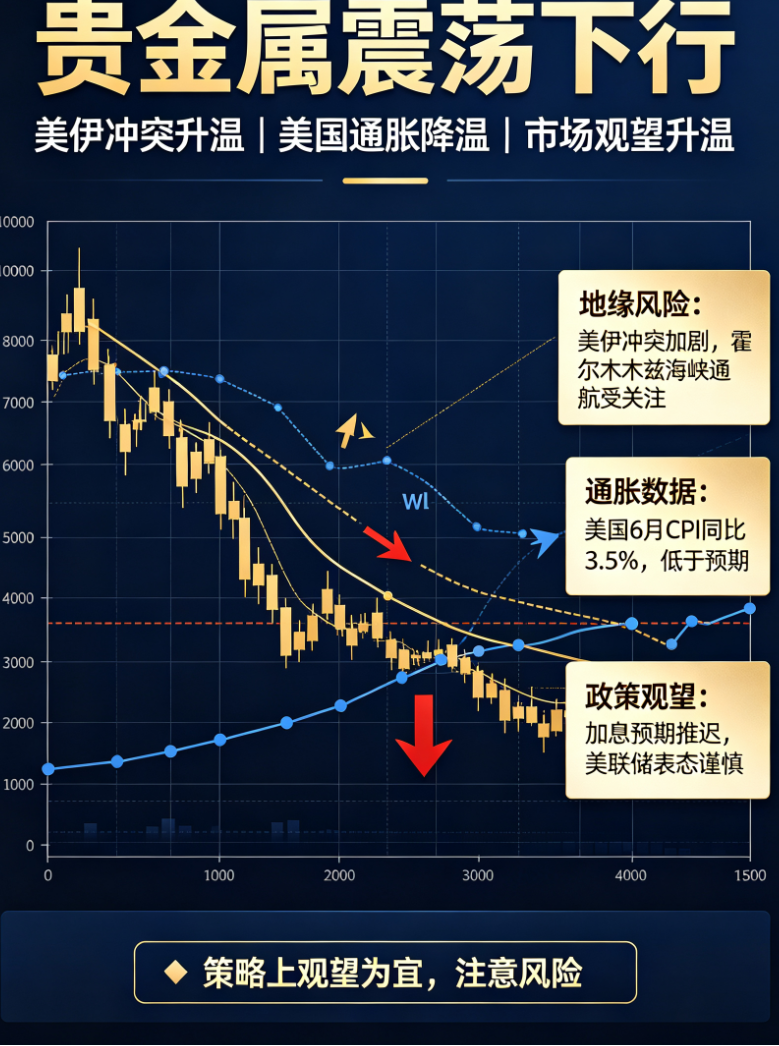
Meanwhile, gold prices did not surge in tandem with oil prices as traditional logic would suggest, but instead showed a pattern of initially rising and then falling. This phenomenon breaks the linear narrative of "soaring oil prices → rising inflation expectations → increased gold demand as an inflation hedge," forcing investors to re-examine the intrinsic logic of asset pricing under geopolitical shocks. This article aims to systematically review and deeply analyze this complex situation.
2. US-Iran Conflict and the Truth About Global Petroleum Reserve "Buffer"
2.1 Driving Factors of Escalation
The confrontation between the US and Iran is not a recent development. In the first half of 2026, the US, citing Iran's breach of enriched uranium purity limits, intensified financial sanctions and military pressure on Iran. Iran retaliated through exercises in the Strait of Hormuz and attacks on Red Sea merchant ships. The "brinkmanship" game between the two sides has entered a dangerous zone. Unlike before, this conflict is compounded by structural contradictions during the global energy transition—insufficient investment has led to sluggish growth in traditional oil and gas production capacity, while renewable energy's replacement of base-load power supply remains inadequate.
The above diagram shows the current geopolitical risk transmission chain for major oil-producing countries in the Middle East. The red areas represent high-conflict zones. The Strait of Hormuz, as the throat for about 20% of global oil transportation, would trigger a global supply crisis if disrupted. Notably, the diagram indicates that the density of military deployments around Iran has approached the level seen during the 2020 assassination of Soleimani.
2.2 "Buffer" Depletion: Fact or Alarmism?
Overseas institutions' concerns that global strategic petroleum reserves are "nearly exhausted" are not unfounded. Data from the International Energy Agency (IEA) shows that as of June 2026, commercial oil inventories in OECD countries were sufficient for only about 55 days of net imports, far below the historical safety line of 90 days. Although the US Strategic Petroleum Reserve has been partially replenished after a historic release in 2022, its current size is only about 350 million barrels, less than half of its peak. European countries, constrained by fiscal pressures and green energy policy orientations, have been slow to replenish strategic reserves.
The blue bars in the diagram represent the latest reserve levels in July 2026, and the yellow dashed line is the IEA recommended safety floor. It can be seen that reserves in major consuming countries such as the US, Japan, and Germany are at relatively low levels. In the event of a large-scale supply disruption, the government's "firepower" for releasing reserves would be far weaker than in the past.
2.3 Possibility of Extreme Supply Crisis and Market Pricing
Current market pricing has partially reflected extreme scenarios: backwardation in crude oil futures has deepened, indicating tight spot supply expectations; refined product crack spreads have surged, especially for diesel and jet fuel. If the conflict escalates further to the point of Iran blocking the Strait of Hormuz or US strikes on Iranian refineries, global oil prices could spike over 30% in the short term, potentially breaking $120 per barrel. However, it should be noted that markets often overestimate the risk premium of low-probability events. Historically, the impact of Middle Eastern crises (e.g., Iraq's invasion of Kuwait, oil embargoes) on oil prices has mostly been impulsive; as long as substantial crude exports are not significantly reduced, prices will eventually return to fundamentals.
3. Linkage Logic Between Oil Prices and Gold: Limited or Significant?
3.1 Traditional Transmission Paths and Reasons for Current Failure
Traditionally, rising oil prices affect gold through three paths: first, by boosting inflation expectations, enhancing gold's appeal as an inflation hedge; second, by dampening economic growth, increasing gold's safe-haven attractiveness; and third, by stimulating central bank gold purchases to hedge against reserve asset depreciation. However, the current situation differs.
First, inflation expectations are partially "desensitized." After the high inflation experience of 2021-2023, the pricing elasticity of global bond markets to oil price shocks has declined. The Federal Reserve and the European Central Bank are now more focused on core services inflation, with energy price volatility seen more as a temporary factor. Therefore, even if crude oil briefly breaks $100, the increase in 10-year breakeven inflation rates may be extremely limited.
Second, safe-haven demand is offset by a stronger US dollar. The US-Iran conflict is often accompanied by a temporary strengthening of the US dollar index (due to safe-haven capital flows into US assets), and the dollar has a negative correlation with gold. This explains why gold prices rose briefly at the onset of military actions but quickly fell back—after digesting geopolitical news, the market refocused on Fed tightening expectations and a strong dollar.
Third, the suppression of real interest rates. Although US real interest rates have fallen slightly from highs, they remain in positive territory. As a zero-yield asset, gold's holding opportunity cost is still relatively high. As long as the Fed maintains a "higher for longer" interest rate stance, gold's upside will be rigidly constrained.
3.2 Empirical Evidence: Gold Performance in Historical Contexts
Reviewing the impact of several major geopolitical conflicts on asset prices in the 21st century: During the 2003 Iraq War, crude oil prices rose sharply before the war, but gold prices only edged up briefly at the start due to panic, then fell sharply as the US military achieved a quick victory. During the 2011 Libyan civil war and the early stages of the 2022 Russia-Ukraine conflict, gold showed similar "impulsive" rises followed by corrections. This confirms CICC Futures' judgment: the impact of oil prices on gold is relatively limited, with the core drivers remaining real interest rates and the US dollar.
4. Short-Term Gold Outlook: Support and Resistance in a Volatile Pattern
4.1 Support Factors: The "Floor" of Safe-Haven Demand
Even if oil price shocks cannot sustain higher gold prices, gold still has a solid "safety floor." First, global central bank gold purchases continue, with emerging market central banks such as China, India, and Turkey steadily increasing holdings. Second, the permanent risk premium from geopolitical uncertainty remains—even if the US-Iran conflict eases temporarily, tail risks (e.g., terrorism, cyberattacks, regional proxy wars) persist. Third, if recession expectations reheat, gold as a defensive asset will attract capital inflows.
4.2 Resistance Factors: Dual Pressure from Interest Rates and the US Dollar
In the short term, gold faces three major headwinds. First, the Fed's September FOMC meeting is approaching; the market remains divided on whether to raise rates, but the "no cut" tone is clear, keeping real interest rates high. Second, US economic data resilience has exceeded expectations, with Q2 GDP growth revised up to 2.8%, sparking "second inflation" concerns and reinforcing rate expectations. Third, rising crop prices in India during the monsoon season may impact rural gold consumption demand, leaving a lack of physical support.
4.3 Scenario Analysis and Key Variables
Based on whether oil prices continue to rise, two scenarios are possible. Scenario 1 (Baseline): Oil prices oscillate in the $80-95 per barrel range, not breaking $100. In this case, gold will fluctuate around $2,300-2,450 per ounce, with a slight downward bias. Scenario 2 (Extreme): The US-Iran conflict triggers a major supply disruption, oil prices break $120 and stay above for over a month. Inflation expectations surge sharply, forcing the Fed to pause rate hikes or even pivot to easing; gold could break $2,600, but the probability is below 20%. Scenario 3 (Easing): The US and Iran reach a temporary ceasefire or the situation is cooled through third-party mediation; oil prices fall back to $75-85. Gold would quickly test below $2,200, but central bank purchases would provide a buffer.
The above chart clearly depicts the linkage between oil and gold prices over the past three months. During the April-May period, as oil rose from $85 to $95, gold only inched up from $2,300 to $2,350, a far smaller increase than oil. After oil corrected in late May, gold edged up slightly, further indicating a weak correlation.
5. Conclusions and Investment Implications
The US-Iran conflict will remain the biggest source of uncertainty for the global energy market in the foreseeable future. The "buffer" of global strategic petroleum reserves has indeed been weakened, but has not yet reached a point of triggering systemic collapse. Market pricing of extreme supply crises includes a reasonable risk premium, but its transmission to gold should not be overestimated. In the current environment, gold is more anchored by US real interest rates and central bank policy frameworks; geopolitical events can only provide brief safe-haven impulses and cannot alter the main trend of volatility.
For investors, a "barbell" allocation strategy is recommended: on one hand, allocate a portion of gold ETFs or physical gold as tail risk hedging, with the position not exceeding 10% of the portfolio; on the other hand, increase exposure to energy stocks positively correlated with oil prices and Treasury Inflation-Protected Securities to capture geopolitical premiums. At the same time, closely monitor Middle East diplomatic developments and Fed statements, and adjust positions promptly once signs of a turning point in the conflict emerge.
In summary, against the shadow of a thinning "oil buffer," market anxiety is understandable, but asset pricing must ultimately return to fundamental facts. Gold's volatile pattern is expected to persist into Q4 2026, awaiting the next catalyst to break the deadlock.