Gold Price High-Level Fluctuation: Market Logic and Outlook After $2100 Breakthrough
Abstract
In early December 2023, the international gold market experienced a historic moment—New York gold futures and London spot gold both broke through the $2100 per ounce mark, setting a new record. However, prices quickly retreated afterwards, showing a high-level fluctuation pattern. This article deeply analyzes the driving factors behind the gold price surge and retreat from multiple dimensions including macro monetary policy, geopolitical risks, market capital flows, and technical aspects, and explores investment logic under short-term pullback pressure and medium- to long-term prospects. The analysis suggests that although Fed rate cut expectations and safe-haven demand provide long-term support for gold prices, inflation stickiness, high U.S. Treasury supply, and the market's overly optimistic rate cut pricing mean gold faces significant short-term pullback risks.
Keywords: gold price, Fed rate hike, rate cut expectations, safe-haven demand, ETF capital flows
I. Introduction: The Frenzy of Historic Highs and Calm Pullback
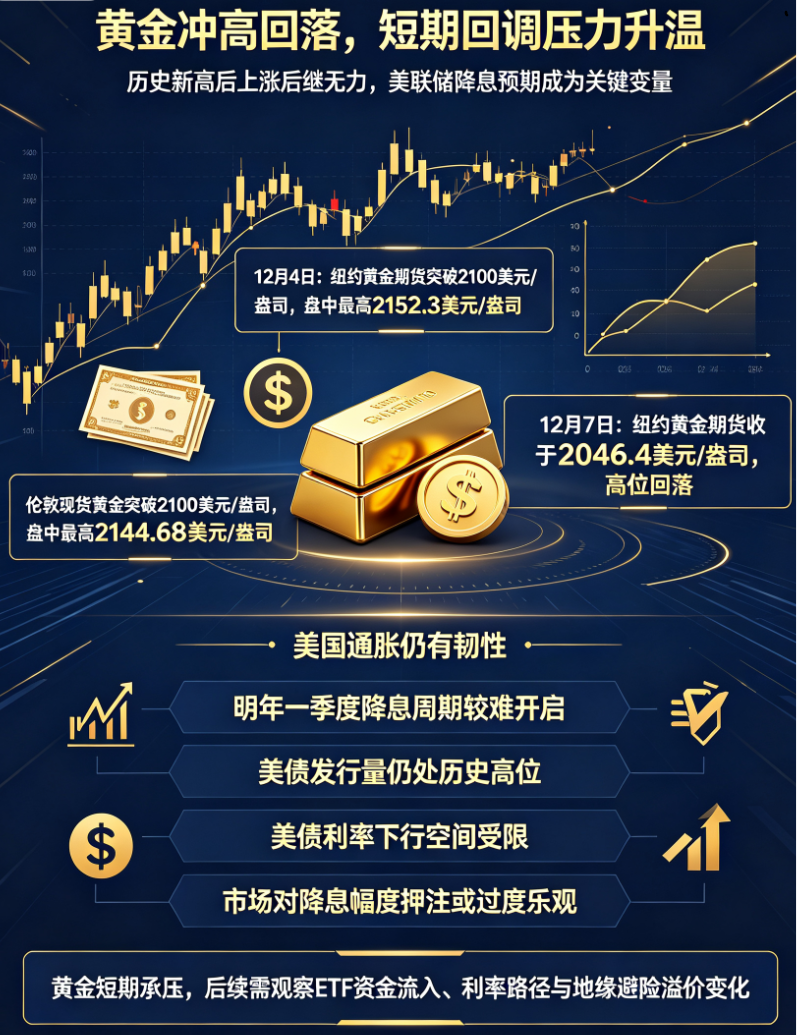
On December 4, 2023, the global gold market was shaken. New York gold futures hit an intraday high of $2152.3 per ounce, and London spot gold reached $2144.68 per ounce, both setting new all-time highs. This breakthrough was driven both by strong market expectations of a Fed policy shift and by safe-haven capital inflows amid ongoing geopolitical conflicts. However, the market's excitement did not last long. In the following trading days, gold prices quickly fell back. As of December 7, the February 2024 gold futures on the New York Mercantile Exchange closed at $2046.4 per ounce, a pullback of over $100 from the historic high. This "roller coaster" trend sparked intense debate among investors about the future direction of gold.
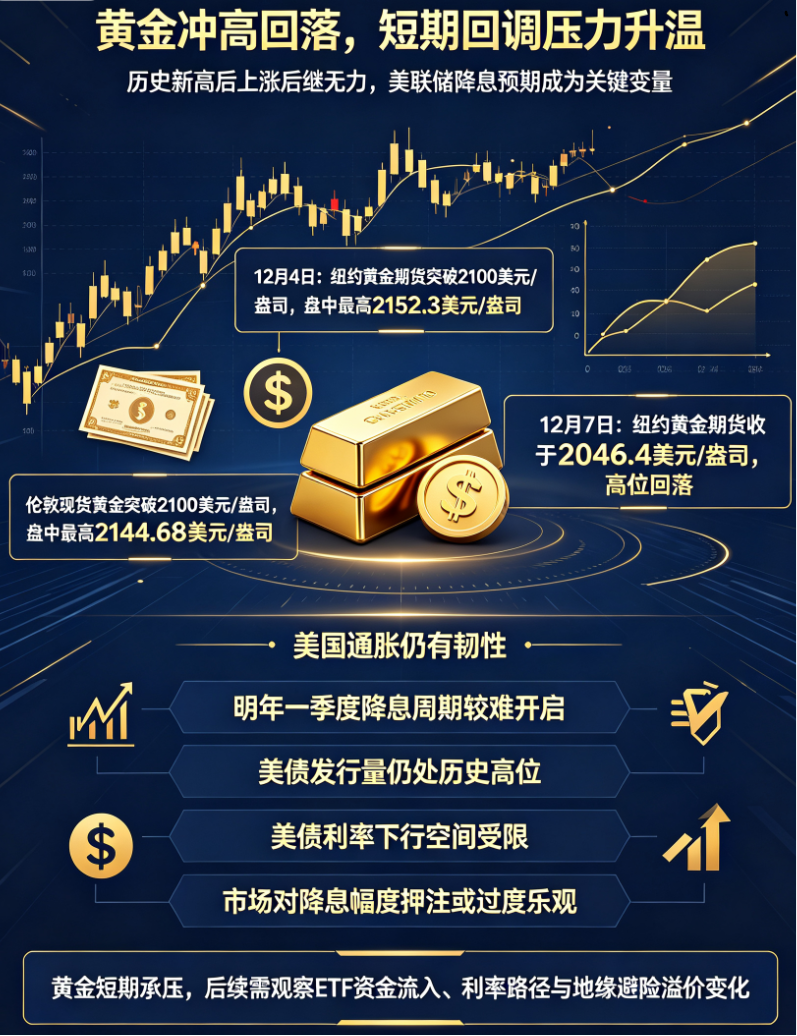
Figure 1: Overview of recent international gold price trends (Source: Public market data)
As shown in Figure 1, gold prices quickly turned downward after breaking $2100, forming a classic "surge and retreat" technical pattern. The logic behind this trend includes both concentrated selling by short-term profit-takers and a repricing of the market's expectations for the Fed's rate cut pace.
II. Core Drivers of the Surge: Rate Cut Expectations and Safe-Haven Demand Resonance
2.1 Shift in Fed Policy Expectations: From "Higher for Longer" to "Rate Cut Window"
The core driver of this gold price rally was the market's bet on a shift in Fed monetary policy. Since November 2023, U.S. inflation data has continued to decline. The October CPI year-on-year rate fell to 3.2%, and core CPI fell to 4.0%, both the lowest since 2021. Meanwhile, the labor market showed signs of cooling, with slower non-farm payroll growth and a slight rise in the unemployment rate. These data led the market to widely expect that the Fed's rate hike cycle was nearing its end, and attention began to turn to the rate cut window in 2024.
The CME "FedWatch" tool showed that around December 4, the market's probability of a Fed rate cut in March 2024 had risen to over 70%. The warming of rate cut expectations directly lowered real interest rates, weakened the appeal of dollar assets, and thus provided strong upward momentum for gold.
2.2 Geopolitical Risks Continue to Escalate: Steady Safe-Haven Capital Inflows
In addition to monetary policy factors, geopolitical risks have also been boosting gold's safe-haven premium. In the fourth quarter of 2023, tensions in the Middle East remained high, the Russia-Ukraine conflict showed no sign of easing, and global trade frictions and geopolitical competition intensified. Against this backdrop, central banks around the world continued to increase their gold reserves, pushing global central bank gold purchases to a historically high level. According to the World Gold Council, global central bank net gold purchases reached 800 tons in the first three quarters of 2023, far exceeding the same period in previous years. This structural demand provided solid bottom support for gold prices.
III. Deep Reasons for the High-Level Retreat: Expectation Correction and Profit-Taking
3.1 Inflation Stickiness Remains; Rate Cut Timing May Be Delayed
However, the market's optimistic expectations about the pace of rate cuts may have been too premature. Although overall U.S. inflation is falling, core service inflation remains sticky, with components like rent and health care not declining significantly. Fed Chair Jerome Powell stated in early December that "it is too early to declare victory over inflation" and emphasized that the Fed is prepared to raise rates further if appropriate. This hawkish remark quickly cooled the market, and the probability of a rate cut subsequently declined.
Mark Haefele, Chief Investment Officer at UBS Global Wealth Management, told Yicai reporters that the market's bets on the magnitude of next year's rate cuts may be overly optimistic. Current U.S. inflation still shows stickiness, making it difficult to start a rate cut cycle in the first quarter of next year, which limits the downside room for U.S. Treasury yields and thus suppresses gold prices.
3.2 Persistent U.S. Treasury Supply Pressure Limits Yield Downside
Another factor not to be overlooked is the supply pressure of U.S. Treasuries. In the first quarter of 2024, the U.S. Treasury is expected to issue a large amount of medium- and long-term bonds to cover the fiscal deficit and repay maturing debt. With the Fed still shrinking its balance sheet, the large supply of Treasuries will push yields higher, thereby supporting real interest rates. Since real interest rates are negatively correlated with gold prices, if real rates cannot significantly decline, further gold price gains will face resistance.
3.3 No Sustained ETF Inflows; Market Sentiment Yet to Solidify
Notably, despite gold prices hitting new highs, inflows into gold ETFs (exchange-traded funds) have not increased in sync. According to statistics from the World Gold Council, global gold ETFs still saw net outflows in November 2023, indicating that investor willingness to hold physical gold has not significantly recovered. Haefele emphasized that for gold to rise further, sustained net inflows into gold ETFs are needed, and this condition is not yet met. Without sustained ETF capital support, market buying power is not solid, and once profit-taking emerges, prices can quickly fall back.
IV. Short-Term Outlook: Pullback Pressure and Support Factors Coexist
4.1 Trading Level: Technical Pullback Pressure Remains
From a technical perspective, gold prices quickly retreated after breaking $2100, forming a potential "double top" or "head and shoulders top" pattern. If prices cannot firmly stand above $2100 in the short term, they may further test the psychological support level of $2000. Additionally, speculative long positions in the market are already at a high level. Once negative news emerges, a long squeeze could amplify the pullback.
4.2 Macro Level: Rate Cut Expectations Still Have Room to Evolve
Although short-term pullback pressure is significant, the bullish logic for gold in the medium to long term has not been completely destroyed. The turning point in Fed monetary policy is only delayed, not eliminated. As the U.S. economy slows and inflation falls further, the probability of starting a rate cut cycle in the second half of 2024 remains high. At that time, the decline in real interest rates will again provide upward momentum for gold prices.
Moreover, the trend of central banks buying gold continues. Global central bank gold purchases for the full year 2023 are expected to exceed 1,000 tons, providing long-term stable physical demand for the gold market. The global de-dollarization trend and geopolitical uncertainty will continue to strengthen gold's strategic position as a reserve asset.
V. Conclusion: Cautious in the Short Term, Optimistic in the Medium to Long Term
In summary, the rapid pullback in international gold prices after breaking $2100 is a rational correction following the market's excessive betting on Fed rate cut expectations. In the short term, factors such as inflation stickiness, U.S. Treasury supply pressure, and insufficient ETF inflows will limit gold's upside, and investors should remain cautious. However, from a medium- to long-term perspective, fundamental factors such as a clear direction for Fed policy shift, continued central bank gold purchases, and lingering geopolitical risks still provide a solid value foundation for gold.
For investors, it is not advisable to blindly chase highs at this stage, but there is no need to be overly pessimistic either. During the gold price consolidation, investors can focus on support near $2000 and combine signals such as inflation data, Fed meeting minutes, and ETF capital flows to make strategic deployments when appropriate. As a safe-haven asset and inflation hedge, gold will continue to play an irreplaceable role amid global economic uncertainty and a period of monetary policy transition.
Main References
- New York Mercantile Exchange gold futures trading data, December 2023.
- Report by Yicai reporter: Interview with Mark Haefele, Chief Investment Officer at UBS Global Wealth Management, December 2023.
- World Gold Council, Global Gold Demand Trends Report, Q3 2023.
- Federal Open Market Committee (FOMC) meeting minutes and public statements.