International Gold Price Breaks $2000 Mark: Prelude to the "Golden Age" of Precious Metals?
Summary
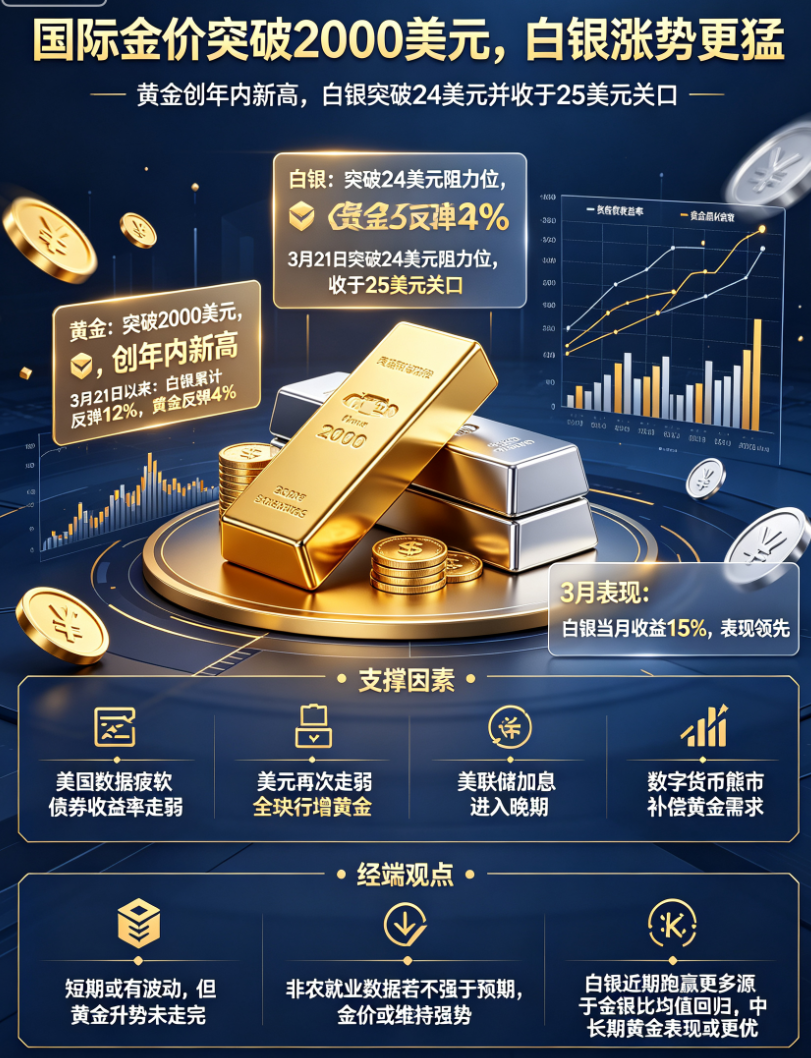
Since March 21, 2023, the international gold price has broken through the $2000/oz mark, hitting a new high for the year. Meanwhile, the silver price has risen even more sharply, breaking through the $24 resistance level and closing at the $25 mark, with a cumulative rebound of over 12% for the month. This collective surge in precious metals has drawn widespread attention from global investors. This article will delve into the driving factors behind the joint strength of gold and silver from multiple dimensions including the macroeconomic backdrop, monetary policy expectations, and market supply-demand dynamics, and provide forward-looking analysis on their future trends.
Introduction
Amid uncertain global economic recovery prospects and rising expectations of a shift in monetary policy by major economies, the precious metals market has once again become a focus of capital. Recently, U.S. economic data has consecutively fallen short of expectations, bond yields have declined, and the U.S. dollar index has weakened significantly. These factors together have provided strong upward momentum for the non-yielding assets gold and silver. Even more notably, silver became the best-performing asset class in March with a monthly gain of 15%, and its "acceleration" in the precious metals sector has sparked heated debate about the relative performance of gold and silver in the future.
Macro Drivers of the Precious Metals Surge
Weak Data and Policy Expectation Shift
Recent U.S. economic data has shown clear signs of weakness. The JOLTS job openings and factory orders data both came in weaker than market expectations. More critically, March ADP employment increased by only 145,000, far below the expected 210,000 and the previous 242,000. The continued weak performance of these data has deepened market concerns that the U.S. economy may fall into recession.

Driven by this pessimistic sentiment, market expectations for the Fed's future policy direction have undergone a significant shift. Currently, the market prices the probability of a 25-basis-point rate hike by the Fed in May at less than 50%. More importantly, the Fed's year-end rate level is expected to be about 65 basis points lower than the current level, meaning the market has begun pricing in the possibility of two to three rate cuts by the Fed before the end of the year. This reversal in policy expectations provides fundamental support for non-yielding assets such as gold.
Weakening Dollar and Strengthened Negative Correlation with Gold
Since the fourth quarter of last year, as inflation data in the U.S. and Europe showed signs of cooling, market expectations for rate hikes by major central banks have declined significantly. The U.S. dollar index has fallen from around 115 to below, with a cumulative decline of over 10%. According to data, the correlation between the dollar and gold over the past 60 days is close to -94%, with this highly negative correlation being particularly pronounced in the current market environment. When the dollar index's downward channel opens, gold denominated in dollars naturally gains strong upward momentum.
It is worth noting that although OPEC+ unexpectedly announced a sharp cut in crude oil supply, which could trigger a new wave of inflation shocks, market participants currently seem more focused on economic recovery prospects than on inflationary pressures. Senior Analyst Razazada of GAIN Group pointed out that if weak economic data continues to ferment, the market will become more convinced that the Fed will not accelerate the pace of rate hikes. The strengthening of this expectation sends a clear positive signal for low-yield and zero-yield assets such as gold and silver.
The Logic Behind Silver's "Overtaking"
Silver's performance in this round of precious metals rally has been exceptionally eye-catching, with its trend characteristics sharing both commonalities and differences with gold. From both monetary and industrial attributes, silver's dual nature determines its more complex price fluctuation characteristics.
Historically, during the initial stages of a bull market in precious metals during economic recession cycles, gold often outperforms silver. Taking the 2008 global financial crisis and the March 2020 COVID-19 shock as examples, when central banks generally adopted accommodative monetary policies, gold's monetary attribute was significantly stimulated, while silver was dragged down by its industrial attribute, resulting in relatively lagging gains.
However, the current market shows a new feature: silver has significantly outperformed gold recently. Multiple investment professionals pointed out that this is mainly because silver suffered an over-correction during the recent banking crisis in Europe and the U.S., and the recent rise essentially represents a mean reversion process of the gold-silver ratio (the ratio of gold to silver futures prices). This correctional rally has provided additional upward momentum for silver in the short term. However, from a medium-to-long-term perspective, most analysts believe that gold's overall performance may be more stable and superior.
Outlook for Gold in the Context of Rate Cut Expectations
Clear Technical Signals
From a technical analysis perspective, gold's current price trend continues to release signals of further upside. In early March, gold broke through the falling wedge pattern, quickly climbed to the $2000 level, and underwent several weeks of consolidation around that level. Notably, gold's downside space in this key area has always been limited, with bulls actively intervening near important support levels such as $1935 and $1960 (the December 2022 high).
With gold successfully breaking through the $2000 mark, the technical picture opens up imagination for the subsequent market. Currently, the market is focusing on two key highs: one is the $2070 high set in March 2022, and the other is the all-time record high of $2075 touched in August 2020. If gold can effectively break through these key resistance levels, it would confirm a new upward trend. Conversely, if gold falls below the $1960 support level, the current bullish technical view would face challenges.
Multiple Fundamental Supporting Factors Resonating
From a fundamental perspective, there are still many supporting factors for gold's future. First, the trend of global central banks increasing their gold holdings continues, with central banks' ongoing allocation to gold reserves providing stable demand. Second, inflation expectations triggered by the oversupply of the U.S. dollar have led more investors to view gold as an effective tool against currency depreciation. Additionally, the prolonged downturn in the digital currency market has prompted some funds to return to gold, further diversifying demand sources.
Looking ahead, the key non-farm payrolls data to be released this Friday will be an important factor affecting short-term gold prices. If the data comes in weaker than expected, it will further reinforce market expectations of a Fed pause or even rate cuts, thereby helping gold maintain its strength. Even if gold may experience a technical pullback in the short term, most market participants believe that the overall upward trend of gold is not over.
Conclusion
The current precious metals market is at a critical period where multiple favorable factors resonate. Recession fears sparked by weak U.S. economic data, expectations that the Fed's rate hike cycle is nearing its end, continued weakening of the U.S. dollar index, and strong central bank demand for gold collectively build a solid foundation for the upward movement of gold and silver prices.
In the short term, the mean reversion process of the gold-silver ratio provides additional upward momentum for silver, as evidenced by silver's outstanding performance in March. However, from a medium-to-long-term investment perspective, gold, with its purer monetary attribute and more stable safe-haven demand, may offer more promising overall performance. As the Fed's policy shift toward easing becomes clearer, the "golden age" of gold may have just begun. While focusing on short-term trading opportunities, investors should also grasp the long-term investment logic of this precious metals bull market.