Gold Volatility Intensifies, Commercial Banks Intensively Tighten Personal Precious Metals Business: A Storm of Rational Return
Introduction
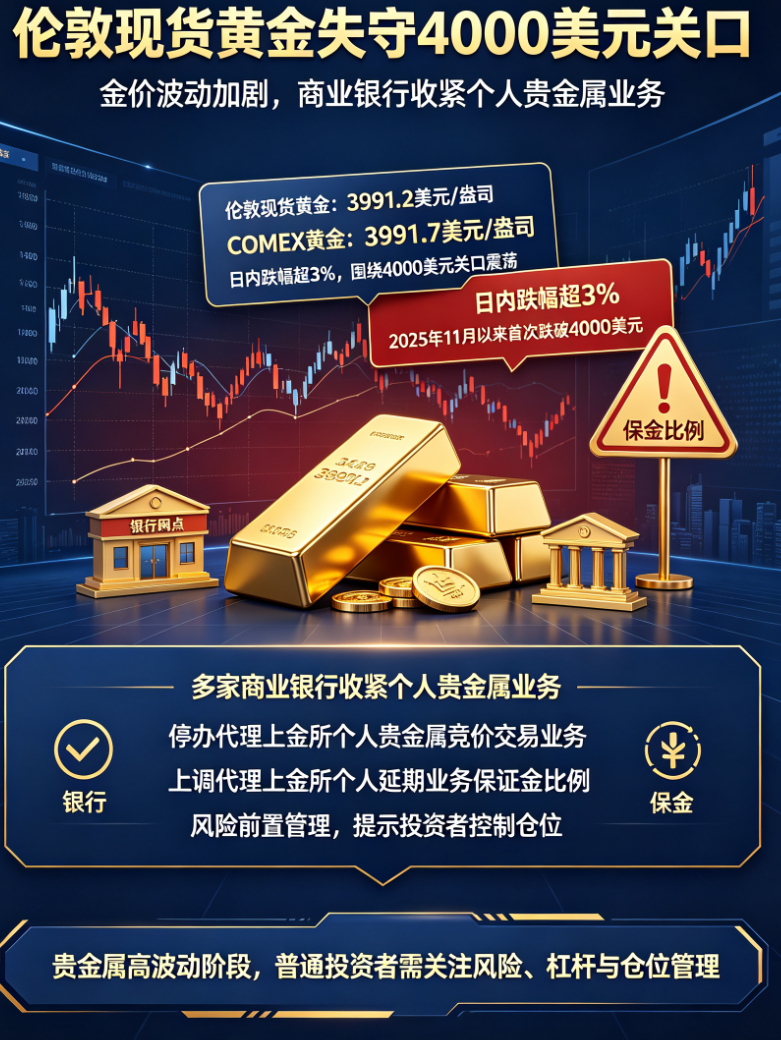
On July 20, 2026, global financial markets witnessed a highly symbolic moment: London spot gold price fell below the psychological threshold of $4,000 per ounce, the first time since November 2025. At press time, London spot gold was quoted at $3,991.2 per ounce, COMEX gold at $3,991.7 per ounce, with gold prices oscillating violently near the $4,000 mark, intraday drop exceeding 3%. This sudden plunge caught investors off guard and triggered a comprehensive upgrade of precious metals business risk management by commercial banks.

Against the backdrop of intensified gold price volatility, multiple commercial banks have tightened personal precious metals businesses since June, including suspending agency personal precious metals auction trading business of the Shanghai Gold Exchange and further raising margin ratios for personal deferred transactions of the exchange. By front-loading risk management, commercial banks are sending a clear signal to ordinary investors: focusing on market volatility and reasonably controlling positions have become the primary principles for precious metals investment.
1. Gold Price Loses $4,000: Causes and Impacts
1.1 Gold Price Drop Under Multiple Factors
As one of the world's most important safe-haven assets, gold price movements often reflect complex changes in global macroeconomics, geopolitics, and financial markets. The gold price falling below $4,000 is not an isolated event but the result of multiple factors working together.
First, the easing of global inflationary pressures is a key factor. After continuous interest rate hikes by central banks, inflation rates in major economies have fallen from highs, weakening demand for safe-haven assets. Second, the strengthening of the US dollar index directly suppressed gold prices. As the pricing currency for international gold, a stronger dollar means downward pressure on dollar-denominated gold prices. Additionally, expectations that major global central banks, especially the Fed, will maintain a tightening stance further heightened market concerns about rising interest rates, diminishing the appeal of gold as a non-yielding asset.
1.2 Systemic Impact of Gold Price Volatility on Market Ecology
Violent gold price fluctuations not only affect investor returns but also profoundly impact the entire financial market ecology. For commercial banks, the risk exposure of agency personal precious metals trading has rapidly expanded. In extreme gold price scenarios, clients may face insufficient margin or even a shortfall, leading to advance funding risks and credit risks for banks. This is the core logic behind the intensive tightening of related businesses by commercial banks.
2. Commercial Banks' Response: From "Active Deleveraging" to "Front-Loaded Risk Management"
2.1 Multiple Banks Intensively Halt Related Businesses
Facing the increasingly complex precious metals market, commercial banks chose to actively deleverage to build risk buffers. China Construction Bank issued a notice on June 25, announcing that from the final settlement on July 24, it would close the agency personal precious metals trading business of the Shanghai Gold Exchange, involving varieties such as Au99.99, Au100g, PGC30g, Au, mAu, Ag, etc.
CCB is not the first to take such measures. On June 24, ICBC announced that from the final settlement on July 24, 2026, it would suspend the agency personal precious metals auction trading business of the SGE. On June 22, Guangfa Bank announced a full halt of its agency personal precious metals trading business of the SGE by the end of June, while suggesting that clients could invest in alternative products like gold accumulation or gold ETFs. Ping An Bank also issued a notice on June 10, stating that it would close the spot contract trading privileges of agency personal precious metals trading business of the SGE after the closing settlement on June 30, 2026.
2.2 Raising Margin Ratios: Hard Constraints on Risk
In addition to shutting down high-risk businesses, raising margin ratios and increasing investment thresholds are also key measures many banks have taken recently to prevent precious metals business risks. Bank of China announced on June 22 that from the closing settlement on June 24, the margin ratio multiplier for gold deferred contracts would be adjusted from 666% to 800%, thereby adjusting the customer margin ratio for gold deferred contracts from 99.9% to 120%, and for silver deferred contracts from 99.96% to 119.91%.
Guangfa Bank also issued a notice on the same day, adjusting the margin ratio for gold and silver deferred contracts from 100% to 140% respectively. Huaxia Bank adjusted the margin ratio for some agency personal precious metals deferred trading from 35% to 120%. These adjustments are not isolated actions but a collective choice of the commercial banking system, reflecting a consistent shift in attitude across the financial industry toward high-risk businesses.
3. Surging Risk, Tightening Compliance, Strategic Shift: Result of Triple Factors
3.1 Market Risk: Credit Crisis in Volatile Markets
"Commercial banks' intensive tightening of personal precious metals businesses is the result of triple factors: surging market risk, tightening compliance requirements, and banks' own strategic contraction," said Xue Hongyan, a special researcher at Sushang Bank, to China Banking and Insurance News. Recent violent gold price fluctuations, especially for leveraged deferred contracts, can easily lead to insufficient customer margin or even shortfalls, bringing advance funding and credit risks to agency banks. For commercial banks, the uncontrollability of such risks has exceeded the reasonable boundaries of their risk tolerance.
3.2 Compliance Regulation: Upgrade of Investor Suitability Management
Regulators are increasingly strict on investor suitability management, emphasizing "seller fulfills duty, buyer bears responsibility." Banks must reassess the match between such high-risk businesses and individual investors' risk tolerance. In recent years, regulatory authorities have repeatedly issued documents requiring financial institutions to strengthen investor protection, specify risk levels of financial products, and ensure they are sold to appropriate investors. Personal precious metals deferred trading, with its high leverage and high risk, does not match the risk tolerance of ordinary individual investors. The tightening of this business by commercial banks is also a proactive response to regulatory requirements.
3.3 Bank Strategic Transformation: From Scale Pursuit to Quality Focus
From the perspective of banks' own development, strategically contracting high-risk businesses and focusing on core operations has become an industry consensus. Against the background of interest rate liberalization and fintech impact, commercial banks increasingly value capital consumption and risk-adjusted returns. Although personal precious metals agency business can generate some intermediary income, its risk costs and management costs are continuously rising. Banks choosing to actively contract this business segment facilitates concentrating resources on core businesses with greater growth potential and controllable risks.
4. Investor Response: Rational Adjustment and Finding Alternatives
4.1 Focus on Volatility, Reasonably Control Positions
For ordinary investors, commercial banks' front-loaded risk management serves as a timely reminder. After the "feast" of continuous gold price rises over the past two years, the market needs to return to rationality. Intensified gold price volatility means investors need to pay more attention to their own risk tolerance, reasonably control positions, and avoid blindly chasing gains or panic selling. Banks adjusting margin ratios essentially require investors to use more sufficient own funds to participate in risky transactions, thereby reducing market risks brought by leverage.
4.2 Finding Alternative Products: Gold Accumulation and ETFs
Notably, while tightening precious metals businesses, multiple banks have also provided alternative products to investors. Guangfa Bank explicitly recommended that clients could invest in alternative products such as gold accumulation or gold ETFs/silver ETFs to continue precious metals investment. These products feature lower thresholds, stronger liquidity, and better risk diversification, making them more suitable for ordinary investors in asset allocation. Gold accumulation has the characteristic of "dollar-cost averaging," effectively reducing timing risk; gold ETFs can be traded on the secondary market with high transparency and liquidity, serving as another rational choice for participating in precious metals investment.
5. Future Outlook: Gold Price Direction and Long-Term Impact of Banking Business Adjustments
5.1 Short-Term Volatility Unlikely to Change Long-Term Trend
Looking ahead, the trajectory of gold prices still faces considerable uncertainty. Global geopolitical risks have not been fully eliminated, and the policy directions of central banks remain subject to changes. In the short term, gold prices may continue to consolidate around $4,000. However, in the long run, gold's status as a key safe-haven asset will not change. Factors such as weakening global economic growth momentum and persistent inflationary expectations still provide support for gold prices. Investors should view gold investment from a long-term perspective rather than over-focusing on short-term fluctuations.
5.2 Long-Term Impact of Banking Business Adjustments
The continuous tightening of personal precious metals businesses by commercial banks will profoundly change the channels and methods by which individual investors participate in precious metals investment. On one hand, it helps screen out qualified investors who truly understand and can bear the risks of precious metals investment; on the other hand, it creates conditions for the healthy and stable development of financial markets. For banks, how to provide compliant, transparent, and convenient precious metals investment services to investors within controllable risk boundaries will be a direction requiring continuous exploration.
Conclusion
The gold price losing $4,000 is a signal of market risk clearance; commercial banks' intensive tightening of precious metals businesses is a manifestation of the financial system proactively preventing risks. For investors, this adjustment is not a bad thing—it brings the market back to reason and investment back to its essence. In a complex market environment, staying calm, making prudent decisions, and allocating rationally are the ultimate paths to asset preservation and appreciation.
The risk management measures of commercial banks have sounded a warning bell for the market. As ordinary investors, we should pay more attention to our own risk tolerance and participate in any high-risk investment activities with a rational, long-term, and prudent attitude. When gold is no longer "shining," investors' brilliance must be illuminated by wisdom and discipline.