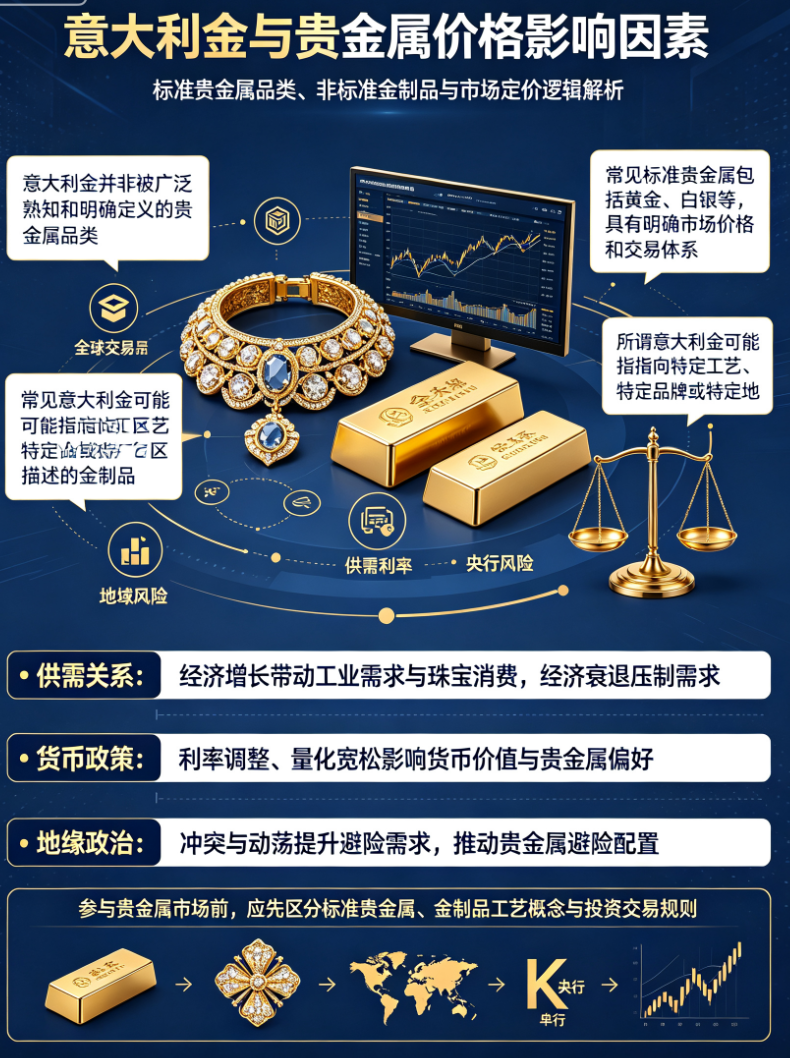
Decoding Precious Metal Market Volatility: The 'Italian Gold' Phenomenon
Keywords: Italian Gold; Precious Metals; Supply-Demand Balance; Monetary Policy; Geopolitics; Investment Analysis
Introduction
In the field of precious metal investment, many non-standard concepts often confuse beginners. The so-called "Italian Gold" is a typical example—it is not an internationally accepted precious metal category, but may refer to a specific type of craftsmanship, brand, or region of gold products, whose value logic differs significantly from standard gold. Setting aside these vague commercial labels, what truly determines the price fluctuations of precious metals are three core variables in the global market: supply-demand balance, monetary policy, and geopolitical risk. Only by deeply understanding these macro factors can investors remain rational amidst information noise and build a robust asset allocation strategy.
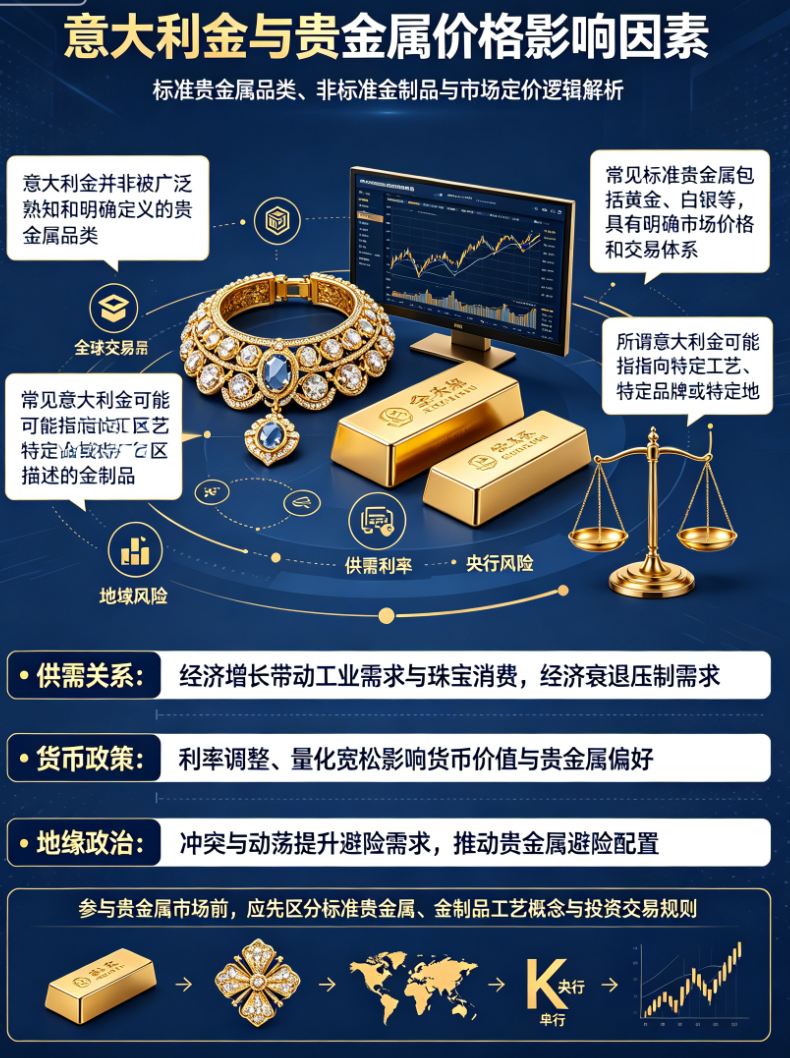
The above figure visually shows the key fluctuation points of precious metal prices in recent years. The following sections will analyze each of the three factors one by one.
1. Supply-Demand Balance: The Foundation of Market Prices
Supply-demand equilibrium is the most fundamental and direct driver of precious metal pricing. On the supply side, global annual mine gold production has long remained around 3,500 tons, mainly from China, Australia, Russia, and other countries. Meanwhile, the supply of recycled gold (recovered gold) fluctuates with gold prices—when gold prices rise, recycling activity accelerates, increasing supply; conversely, when prices fall, supply contracts. This supply elasticity is limited, and mine development cycles are long, making it difficult to respond quickly to price signals in the short term.
The demand side is more complex. The consumption structure of gold is roughly divided into jewelry (about 50%), investment demand (about 30%), and industrial and central bank reserves (about 20%). When the global economy recovers strongly, rising household incomes drive jewelry consumption, while demand for precious metals such as silver and platinum in industrial electronic components rises, increasing overall precious metal demand and making prices prone to rise and resistant to fall. For example, in 2023, the surge in jewelry demand during India's wedding season, coupled with the recovery of the Chinese market, directly supported the medium-term trend of gold prices. Conversely, if an economic recession hits, consumption and industrial demand shrink simultaneously, putting downward pressure on prices. This logic is particularly evident in the silver market—because its industrial use accounts for more than 60%, the impact of economic cycles on its price is far greater than that on gold.
2. Monetary Policy: The Valve of Liquidity and Confidence
The monetary policies of major economies are the "invisible hand" of the precious metal market. Taking the Federal Reserve as an example, its interest rate decisions are transmitted to precious metal prices through three channels: real interest rates, the US dollar exchange rate, and inflation expectations. When central banks implement interest rate cuts or quantitative easing (QE), real interest rates fall, reducing the opportunity cost of holding non-interest-bearing assets (such as gold), and funds flow from interest-bearing assets like bonds to precious metals. At the same time, loose policy often leads to a weaker US dollar, pushing up gold prices denominated in US dollars. Conversely, a rate hike cycle attracts capital back to US dollar assets, suppressing gold prices.
It is worth noting that inflation expectations themselves are also a key variable. Even if nominal interest rates remain unchanged, if the market expects inflation to continue rising, real interest rates still fall, highlighting the value of gold as a traditional inflation hedge. After the COVID-19 pandemic in 2020, central banks worldwide greatly expanded their balance sheets, and gold prices briefly broke through the historical high of $2,075 per ounce—a concentrated manifestation of this logic. Investors should closely track central bank policy statements, interest rate dot plots, and inflation data, as these often indicate the medium-term direction of the precious metal market.
3. Geopolitics: The Price Amplifier of Risk Aversion
Geopolitical risk is a catalyst for short-term sharp fluctuations in precious metal prices. Events such as wars, sanctions, regime changes, or major terrorist attacks can instantly trigger market panic, prompting investors to rush to sell risk assets like stocks and pour into traditional safe havens such as gold and silver. This "risk premium" often quickly pushes up prices in the early stages of an event, then gradually declines as the situation clarifies or risk fades.
Typical examples include: after the outbreak of the Russia-Ukraine conflict in 2022, gold prices surged from $1,800 to $2,070 within two weeks; in 2023, the Israel-Hamas conflict again boosted risk aversion, pushing gold prices back above $2,000. In addition, long-term geo-economic confrontations (such as Sino-US trade frictions and instability in Middle East oil-producing countries) can persistently disrupt supply chains and indirectly affect industrial demand expectations for precious metals. Investors need to establish a framework for assessing the impact of geopolitical events, distinguishing short-term shocks from structural changes, and avoid making irrational trading decisions driven by emotions.
Conclusion
Returning to the topic of "Italian Gold," its ambiguity precisely reminds us: in precious metal investment, the premium attached by brand, origin, or craftsmanship must ultimately return to the true value of the precious metal itself—that is, the international market price. What determines this price is the balance of global supply and demand, the game of monetary policies among countries, and the ups and downs of geopolitics. For investors, rather than chasing concepts, it is better to delve deeply into the three variables above and build an investment logic based on fundamental analysis. As the saying goes, remove the false and retain the true; see the small to know the big. Only by penetrating appearances can one grasp the true anchor of value in a volatile market.