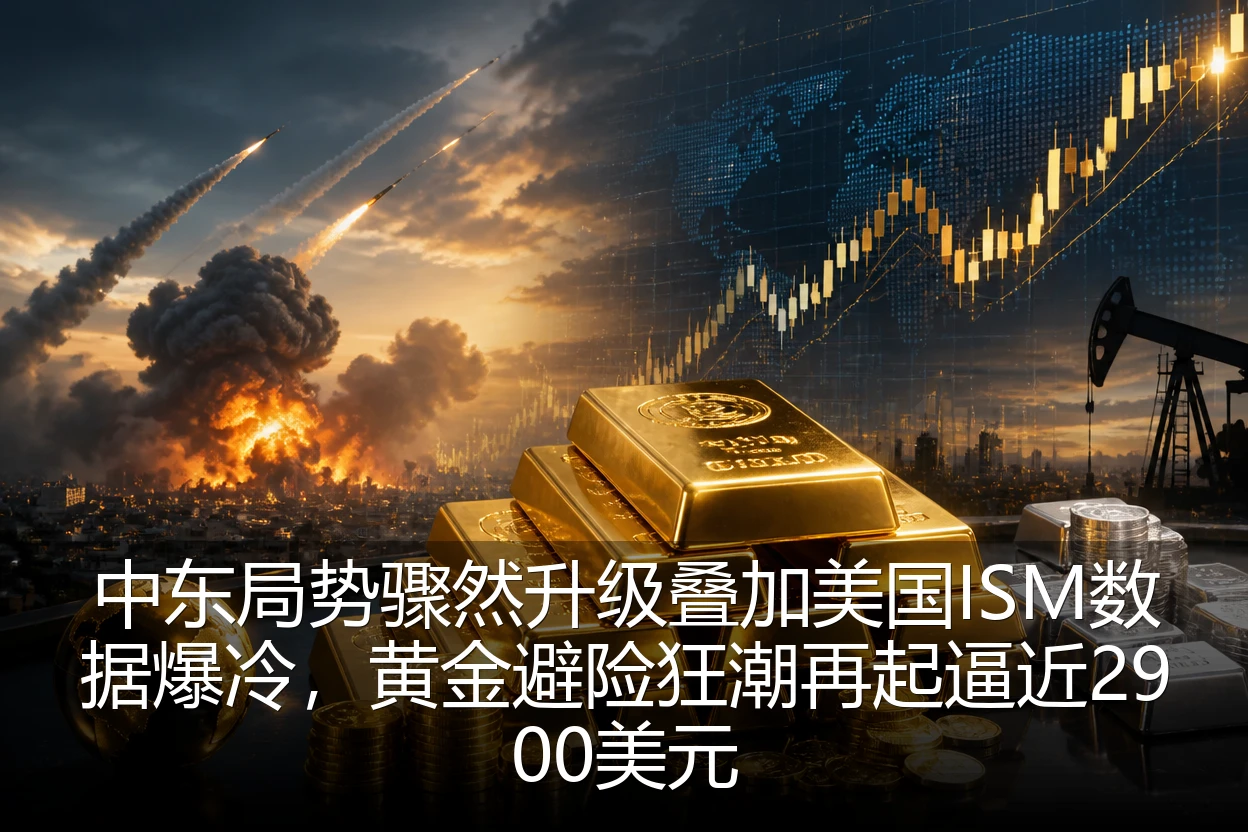
Gold breaks record highs: geopolitical conflict and recession fears strike together
On August 2, 2026, global precious metals markets experienced a violent safe-haven storm. Over the past weekend, geopolitical tensions in the Middle East suddenly escalated sharply, rattling global financial markets. Meanwhile, the latest U.S. July ISM manufacturing PMI unexpectedly plunged, reigniting fears of a U.S. economic recession. Under the twin blows, risk assets were sold off, while gold and silver—traditional safe havens—saw a stunning wave of buying.
As of writing, spot gold was up more than 2% on the day, hitting an intraday high of $2,895/oz, easily recouping the prior week's losses and setting a new intraday high for 2026, just shy of the psychological $2,900 level. Spot silver also followed gold higher, up over 3% on the day and back above $34/oz. The gold/silver ratio briefly rebounded amid risk aversion.
Deep dive: Why did ISM data accelerate gold's rally?
One direct trigger for the surge was the just-released U.S. July ISM manufacturing PMI. The reading not only missed the prior value but also fell well below market expectations, dropped below the boom-bust line, and hit a one-year low. As a key leading indicator of U.S. economic health, the sharp ISM contraction sent a clear signal: the negative effects of the Fed's prolonged high-rate policy are accelerating, and manufacturing activity is cooling significantly.
The data completely changed market expectations for Fed policy. Although Fed officials had repeatedly sent hawkish signals to curb rate-cut expectations, the weak data led traders to ignore official rhetoric. CME's FedWatch tool showed that after the release, market expectations of a September or even emergency August rate cut surged. For gold, a zero-yield asset, rising rate-cut expectations greatly reduce the opportunity cost of holding gold, attracting large capital flows from Treasuries and dollar assets into precious metals.
In addition, the dollar index plunged after the data, breaking below a key support level. A weaker dollar further boosted dollar-denominated gold, forming the classic safe-haven chain: weak economy → weak dollar → higher gold.
Geopolitics deteriorate sharply: safe-haven buying pours in regardless of cost
If weak economic data provided the "fundamental base" for higher gold, the weekend's sudden escalation in Middle East conflict was the "emotional powder keg" that ignited the market. Reports say tensions in the region sharply escalated over the weekend, with significantly increased risk of conflict expansion, even prompting concerns about energy supply disruptions. International oil prices also spiked at the open, further amplifying global inflation expectations and risk aversion.
In this highly uncertain environment, investors' urgency to seek safety was unprecedented. Not only traditional futures and spot markets, but also global gold ETFs saw huge net inflows in early trading. This indiscriminate "buying spree" reflects fund managers' extreme anxiety over current geopolitical risks. For Thai investors, this anxiety was also reflected in the local market.
Thailand market linkage: gold ETFs and physical bars see simultaneous demand surge
As a major gold trading hub in ASEAN, Thailand's market reacted very sensitively to the global risk-off wave. Gold ETFs listed on the Stock Exchange of Thailand (SET) gapped up at the open with significantly higher volume, showing Thai investors using ETFs to quickly build safe-haven positions. Data monitored by our site showed the intraday premium of major Thai gold ETFs widened at one point, indicating extremely strong buying demand.
At the same time, Thailand's gold bar market saw a long-absent frenzy. Long queues formed outside gold shops in Bangkok's Chinatown as investors rushed to buy physical gold bars for safety. Affected by surging international gold prices and baht exchange rate fluctuations, local Thai gold quotes were raised several times during the day, with premiums widening notably. This dual rush—both digital ETFs and physical bars—fully confirms Thai investors' deep concern about global macro risks and their firm belief in gold as the ultimate store of value.
Outlook: Is $2,900 the end or a new beginning?
Looking ahead, volatility in precious metals is expected to remain high in the coming weeks. Several top Wall Street banks urgently updated their gold forecasts today, generally believing that if the Middle East situation does not show signs of easing soon and upcoming U.S. employment data remain weak, gold will quickly hold above $2,900 and challenge the $3,000 level within the year.
For investors, the current environment is full of challenges and opportunities. On one hand, chasing gold requires caution about profit-taking and technical corrections; on the other, amid the reshaping of global geopolitical order, accelerating de-dollarization, and continued central bank gold buying, gold's strategic role as a portfolio ballast remains unshakable. We suggest investors closely watch the global central bank meeting in mid-August and the U.S. July nonfarm payrolls, as these key events will further clarify gold's long-term trend. Meanwhile, using flexible tools such as Thai gold ETFs for position management will be a wise choice in the current high-volatility environment.