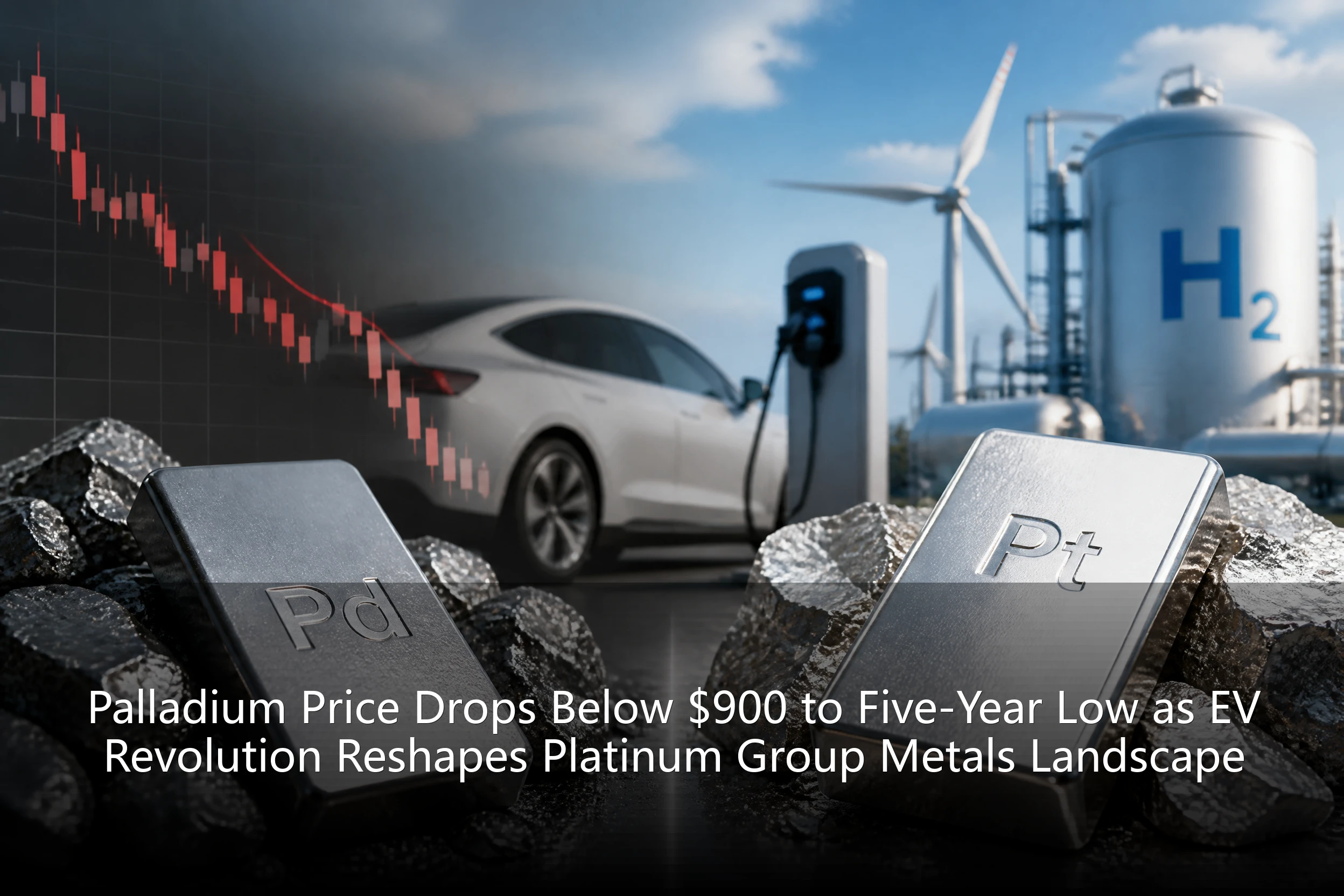
Palladium Crash Breaches Key Psychological Level
On August 4, 2026, the precious metals market witnessed a landmark moment. Spot palladium prices fell below the $900 per ounce mark during early Asian trading, hitting a low of $892.50, the weakest level since March 2021. At the time of writing, palladium was trading at $896, with a year-to-date decline exceeding 15%. This represents a staggering 74% drop from its all-time high of $3,440 in March 2022, marking one of the most severe price collapses in the commodity markets in recent years.
Meanwhile, its sister metal platinum has shown relative resilience, holding near $1,120 with a year-to-date gain of nearly 8%. The price ratio of palladium to platinum has sharply contracted from 2.3 times in 2022 to 0.8 times, completely reversing the long-standing premium structure. Behind this divergence lies a profound structural shift driven by the accelerating switch in global automotive powertrain technology.
EV Penetration Breaks Critical Point, ICE Catalyst Demand Shrinks Irreversibly
Approximately 80% of palladium demand comes from automotive catalysts used in gasoline vehicle exhaust purification. However, the global EV market achieved a milestone breakthrough in the first half of 2026. According to the latest data from the International Energy Agency (IEA), global EV sales accounted for over 30% of total new car sales for the first time in Q2, with the Chinese market approaching 50%. Key advances in solid-state battery mass production technology have pushed mainstream model ranges beyond 600 kilometers, significantly alleviating consumer 'range anxiety' and further accelerating the replacement of internal combustion engine vehicles.
Automakers are rapidly adjusting their production capacity layouts. Volkswagen Group announced last week it was raising its 2030 EV sales share target from 70% to 80% and plans to close at least three internal combustion engine production lines by 2028. Luxury brands like BMW and Mercedes-Benz have also significantly cut their gasoline vehicle R&D budgets. This trend directly impacts palladium demand expectations; consultancy Metals Focus has lowered its 2027 forecast for automotive catalyst palladium demand by 12% to 6.2 million ounces, a contraction of nearly a quarter from the 2025 peak.
Platinum Rises on the Back of the Hydrogen Economy
In stark contrast to palladium's bleak outlook, platinum is benefiting from the explosive growth of the green hydrogen economy. Platinum is a core catalyst for Proton Exchange Membrane (PEM) water electrolysis for hydrogen production and hydrogen fuel cells. In the first half of 2026, global electrolyzer installed capacity grew by 45% year-on-year, with the PEM technology route's share increasing from 25% in 2024 to 35%. The full implementation of the second phase of the EU's Carbon Border Adjustment Mechanism (CBAM) and the enhanced green hydrogen tax credits under the US Inflation Reduction Act provide solid policy support for platinum demand.
The latest report released by the World Platinum Investment Council (WPIC) in July shows that the global platinum market will experience a supply deficit for the fourth consecutive year in 2026, with the shortfall expected to reach 485,000 ounces, 15% larger than the forecast at the beginning of the year. Multiple overlapping factors, including persistent instability in South Africa's power supply, declining mine ore grades, and restricted Russian exports, have severely limited supply-side elasticity for platinum. The WPIC predicts that platinum prices could challenge the $1,200 mark within the next 12 months.
Supply-Side Divergence: The Dual Narratives of Russia and South Africa
The palladium supply side also faces a complex situation. Russia's Nornickel, the world's largest palladium producer accounting for over 40% of global output, remains a key factor. Although Western sanctions persist, routes for Russian palladium re-exports through the Middle East and Asia have largely been established, meaning actual supply has not tightened as significantly as the market expected. Nornickel's Q2 palladium production fell by only 3% year-on-year, better than analyst expectations, further dampening bullish sentiment.
In South Africa, miners like Anglo American Platinum (Amplats) and Sibanye-Stillwater are under pressure from the continuously declining 'basket price' of platinum group metals (PGMs). As palladium typically accounts for a high proportion of PGM output, its price collapse has eroded mining company profits. Sibanye-Stillwater's CEO warned during a July earnings call that if palladium prices remain below $900, some high-cost South African mines face closure risks, which could lead to a passive contraction in platinum by-product output, paradoxically pushing platinum prices higher from the supply side.
Investor Behavior and ETF Fund Flows
Global platinum and palladium ETF holdings data clearly reflect the structural shift in fund flows. According to Bloomberg statistics, as of the end of July, global platinum ETF holdings saw net inflows for four consecutive months, with total holdings rising to 3.2 million ounces, a new high since 2022. In contrast, palladium ETF holdings continued to bleed, with a net outflow of 42,000 ounces in July, bringing total holdings down to 650,000 ounces, halving from the 2024 peak.
For Thai investors, this trend holds significant reference value. Platinum ETF products in the Thai market (such as feeder products tracking the Sprott Physical Platinum Trust) have attracted notable capital inflows this year, while trading volumes for palladium-related products have plummeted. Analysts from the Thai Precious Metals ETF Investment Network point out that Southeast Asian investors' interest in platinum has markedly increased, partly because platinum's strategic role in the hydrogen energy industrial chain aligns closely with ASEAN countries' green transition policies. The Thai government's previously announced 'National Green Hydrogen Roadmap' explicitly prioritizes PEM electrolyzers, providing structural support for platinum demand.
Future Outlook: Platinum-Palladium Divergence Likely to Widen
Looking ahead to the second half of 2026, most institutions believe the price divergence trend between platinum and palladium will persist or even intensify. Goldman Sachs' commodity research team stated in their latest report that palladium may face 'permanent demand destruction,' and even if a short-term rebound occurs due to supply disruptions, the long-term downtrend is hard to reverse. The bank lowered its 12-month palladium price target to $800. For platinum, Citibank maintains its forecast range of $1,150-$1,250, believing hydrogen demand will enter an explosive growth phase starting in 2027.
However, there are dissenting voices in the market. Some contrarian investors believe that the sharp drop in palladium prices has fully priced in negative factors, and if large-scale production cuts by South African miners lead to a sudden supply contraction, a technical rebound could be triggered. Additionally, with US June inflation data falling more than expected, market bets on a Federal Reserve rate cut in September have increased. If the US dollar enters a depreciation cycle, it could provide phased support for the entire precious metals sector.
For Thai investors, the current divergence in the platinum and palladium markets offers a window for cross-asset allocation consideration. Against the macro backdrop of an irreversible EV substitution trend, platinum, as the 'catalyst metal' of the hydrogen economy, holds long-term allocation value, while palladium warrants caution against 'value trap' risks. Investors are advised to closely monitor South African PGM production data, the progress of global hydrogen investment projects, and the Federal Reserve's monetary policy path to dynamically adjust their precious metals ETF holding structures.