Multi-Dimensional Insights into Precious Metal Value Volatility: Investment Strategies and Market Perspectives from a Global View
Keywords
Precious Metals, Gold, Silver, Global Economy, Political Risk, Supply-Demand Analysis, Investment Strategy, Inflation, Safe-Haven Assets
Introduction
In today's highly interconnected global economy, precious metals, as the oldest wealth carriers in human civilization, play an irreplaceable role in the grand narrative of financial markets. Gold, silver, platinum, and other precious metals not only carry millennia of collective trust in value storage but also serve as core indicators in modern financial systems for measuring risk appetite, forecasting economic cycles, and hedging inflation risks. However, with profound changes in the global economic landscape, normalization of geopolitical risks, and continuous financial innovation, the determinants of precious metal prices are becoming increasingly complex and diverse. For investors and economic observers, understanding these deep influence mechanisms is not only a prerequisite for grasping investment opportunities but also an important path to insight into the global economic pulse.
This article systematically analyzes the internal logic and external drivers of precious metal price fluctuations from multiple dimensions including international economic data, political and geopolitical situations, fundamental supply-demand structures, monetary policy trends, and market psychological expectations, providing readers with a complete, in-depth, and practical analytical framework.
1. International Economic Data: Macro Indicators for Interpreting Precious Metal Value
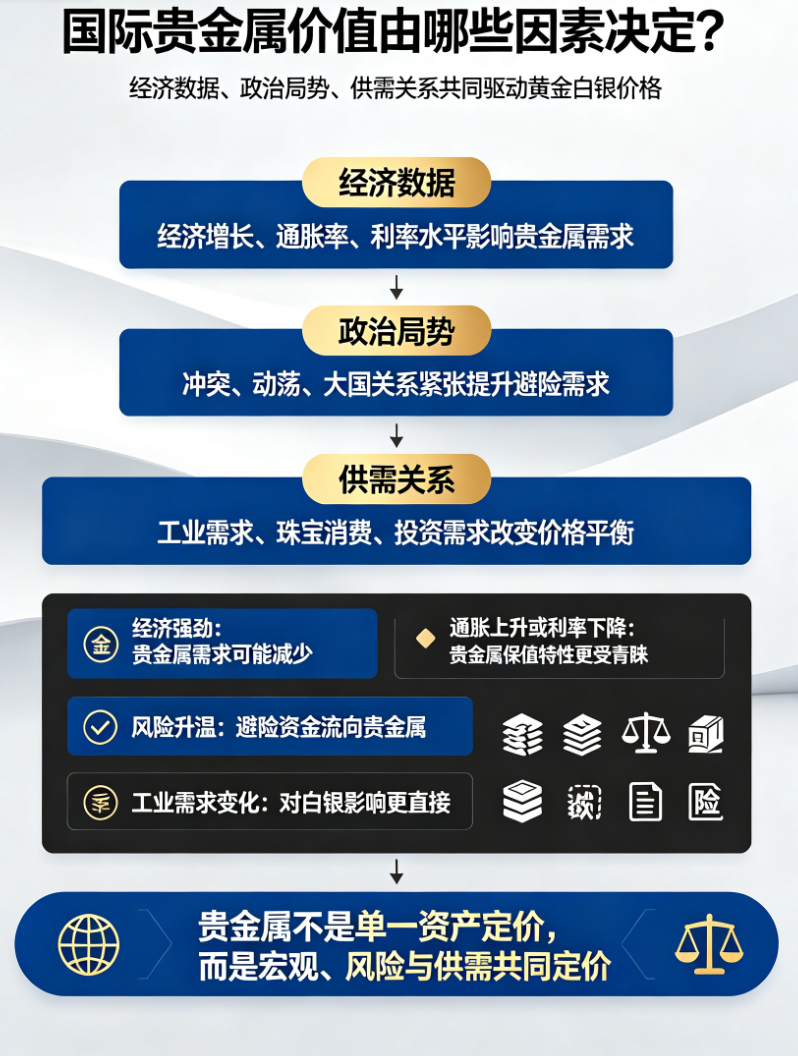
Macroeconomic data are the most fundamental forces affecting precious metal prices. In investment practice, regularly published data by central banks and authoritative institutions on economic growth (GDP), inflation (CPI/PPI), employment (non-farm payrolls, unemployment rate), interest rates, and consumer confidence index all significantly impact precious metal prices through different transmission mechanisms.
1.1 Counter-Cyclical Relationship Between Economic Growth and Precious Metal Demand
Generally, economic growth data of major global economies show a certain negative correlation with precious metal prices. When major economies like the US, China, and the Eurozone release strong GDP growth data, real economic vitality strengthens, corporate earnings expectations rise, and investors' risk appetite increases. In such an environment, funds tend to flow from safe-haven assets like gold to risk assets such as stocks and commodities, exerting downward pressure on precious metal prices.
Conversely, when economic data disappoint or recession signals emerge, concerns about the economic outlook quickly generate safe-haven demand. At this point, gold, as the ultimate safe-haven asset, often rises against the trend. For example, during the 2008 global financial crisis, despite all asset classes suffering heavy losses, gold rebounded quickly after a short-term adjustment and hit historic highs in subsequent years, fully demonstrating its role as a safe harbor in economic headwinds.
1.2 Inflation: Core Driver for Precious Metal Preservation
Inflation rate is one of the most critical variables affecting precious metal value. When inflation persistently rises, especially beyond central bank target ranges, the purchasing power of fiat currencies rapidly erodes. In such cases, investors seek assets that can hedge inflation risks, and gold, silver, and other precious metals become the most favored inflation hedges due to their scarcity, non-renewability, and long historical role as monetary anchors.
Notably, inflation expectations sometimes impact precious metal prices more significantly than actual inflation data. When the market broadly expects future inflation to intensify, investors position in advance, driving precious metal prices up. Conversely, even if current inflation is high, if central banks take strong tightening measures convincing the market that inflation will quickly subside, the upward momentum of precious metals will be curbed.
1.3 Interest Rate Policy: Opportunity Cost Analysis for Precious Metals
Interest rates, especially real interest rates (nominal rate minus inflation), are core variables determining precious metal prices. When real rates are negative, the opportunity cost of holding non-yielding assets like gold decreases, as returns from bonds or deposits have been eroded by inflation. In this scenario, investors are more willing to shift funds to gold, pushing prices up.
Rate decisions by major central banks such as the Federal Reserve, European Central Bank, and People's Bank of China are key drivers for precious metal markets. For example, when the Fed cuts rates or implements quantitative easing, the dollar weakens, real rates fall, and gold prices typically experience an upward rally. In contrast, rate hike cycles are often accompanied by periodic pressure on precious metal prices.
2. Political and Geopolitical Situations: Safe-Haven Logic Amid Uncertainty
The evolution of the global political landscape and the outbreak of geopolitical conflicts are catalysts for sharp short-term fluctuations in precious metal prices. Unlike cyclical macroeconomic data changes, political factors are often sudden and unpredictable, capable of rapidly altering market sentiment and capital flows.
2.1 Geopolitical Conflicts and War Risks
Traditional geopolitical risk events such as regional armed conflicts, terrorist attacks, and nuclear issues typically trigger a global wave of risk aversion. For instance, tensions in the Middle East, the outbreak and escalation of the Russia-Ukraine conflict, and the nuclear crisis on the Korean Peninsula have all driven significant gold price increases in specific periods. The logic: war and conflict-induced uncertainty disrupts normal economic activity, forcing investors to abandon risk assets and seek the safest haven.
2.2 Great Power Competition and Sanction Regimes
Beyond traditional hot conflicts, nontraditional geopolitical risks like trade frictions among great powers, technological blockades, and financial sanctions also profoundly impact precious metal markets. During the US-China trade war, heightened concerns over global supply chain disruptions and economic slowdown pushed gold prices to multi-year highs. Moreover, Western financial sanctions excluding Russia from the SWIFT system triggered deep reflection among global central banks on the safety of dollar assets, fueling an ongoing wave of central bank gold reserve accumulation.
2.3 Impact of Sanction Risks on Precious Metal Trade
Significantly, sanctions targeting specific countries or entities can directly alter global precious metal trade flows and circulation costs. For example, the ban on Russian gold imports prompted some gold to shift to Asian markets, changing original pricing systems and regional spreads. This reminds investors that when analyzing geopolitical impacts on precious metals, they should not only focus on sentiment but also deeply understand the substantive impact on actual supply chains.
3. Supply and Demand: Decisive Force at the Micro Level
Although macro factors and risk sentiment dominate medium- to long-term trends of precious metal prices, the ultimate price outcome is still determined by the most basic market force: supply and demand. The supply-demand structures for different metals like gold, silver, and platinum vary significantly, requiring detailed separate analysis.
3.1 Supply Side: Competition Between Mined Gold and Recycled Gold
In global gold supply, mined gold accounts for about three-quarters, with the remainder coming from recycled gold (old jewelry, industrial waste, and central bank sales). Mined gold supply is constrained by mine construction cycles, declining ore grades, rising extraction costs, and stricter environmental regulations, making it relatively inelastic. In recent years, the pace of major gold discoveries has slowed, and new mine projects have decreased, limiting long-term supply growth potential.
At the same time, central bank gold sales have shifted from net suppliers to net demanders. Since 2010, global central banks, particularly those in emerging markets, have continuously increased their gold reserves, significantly altering the gold market supply-demand balance and providing a solid floor for gold prices.
3.2 Demand Side: Multiple Structures of Investment, Consumption, and Industrial Use
Gold demand mainly comprises jewelry, investment (bars, coins, ETFs), and industrial applications (electronics, aerospace). Jewelry consumption is heavily influenced by economic growth, income levels, and cultural traditions (e.g., Indian wedding season, Chinese New Year). Investment demand is the most sensitive, reacting quickly to global interest rates, inflation expectations, and market risk sentiment.
Unlike gold, industrial applications (solar panels, electronics, automotive catalysts, medical) account for over 50% of silver demand. Therefore, global industrial production activity has a much greater impact on silver prices than gold. In recent years, global energy transition driving rapid solar photovoltaic industry growth has steadily increased industrial silver demand, becoming a key support for silver prices. When analyzing silver, investors must consider both its financial and industrial attributes.
3.3 Specifics of Platinum Group Metals
Platinum and palladium, as representatives of platinum group metals, have significantly different supply-demand logic from gold and silver. Their main use is in automotive catalytic converters, making them heavily influenced by the auto industry (especially technology choices between diesel and gasoline vehicles) and emission regulations. In recent years, with the rising penetration of electric vehicles and the trend of palladium being replaced by platinum in gasoline catalysts, price trends for platinum and palladium have diverged markedly, offering cross-metal arbitrage opportunities for professional investors.
4. Market Sentiment and Speculative Behavior: Short-Term Drivers Not to Be Ignored
In actual market operation, precious metal prices are not purely linearly determined by fundamentals. Investor psychological expectations, market sentiment, speculative fund inflows and outflows, and technical analysis forces often amplify or distort fundamental signals, causing overbought or oversold conditions.
4.1 VIX Fear Index and Gold's Inverse Indicator
The VIX (CBOE Volatility Index) is widely regarded as a barometer of market risk appetite. When the VIX spikes sharply, it is often accompanied by severe stock market declines, while funds flow into safe-haven assets like gold. This sentiment-driven capital flow can push gold prices to levels detached from fundamentals within a short period. Similarly, in extremely risk-on market environments (such as tech stock bull markets), gold may suffer fund outflows.
4.2 Futures Market Positioning Structure
COMEX gold futures positioning data provides a window into speculative forces. Net long positions held by managed funds (hedge funds, CTAs, etc.) show a strong positive correlation with gold price trends. When net long positions are at extreme highs, it often indicates overheated market sentiment and potential price corrections; when net long positions shrink dramatically or even turn net short, it may signal extreme pessimism and often marks the formation of medium- to long-term bottoms.
4.3 ETF Flows and Retail Investor Behavior
Changes in gold ETF holdings directly reflect global retail investors' allocation willingness toward gold. During the 2020 COVID-19 global financial turmoil, gold ETF holdings surged to historic highs, pushing gold prices to a record above $2070. Subsequently, as the Fed aggressively hiked rates, ETF holdings consistently declined, becoming a significant factor weighing on gold prices. Tracking these flow data helps investors identify turning points in market sentiment.
5. Comprehensive Strategy: Building a Dynamic Framework for Precious Metal Investment
Based on the above analysis, successful precious metal investment requires establishing a dynamic, multi-dimensional analytical framework, rather than relying solely on a single factor or simple technical indicators.
5.1 Long-Term Allocation: Hedging Systemic Risks
For long-term investors, it is recommended to allocate gold and other precious metals as a strategic component of their investment portfolio, typically 5%-15%. The core value lies in hedging extreme tail risks: when extreme events such as financial crises, wars, or hyperinflation occur, gold often outperforms all other asset classes. From this perspective, the insurance attribute of precious metals is far more meaningful than pursuing short-term high returns.
5.2 Swing Trading: Capturing Changes in Key Variables
For investors with some experience, swing trading can be conducted around changes in key variables. For example: when the Fed signals a clear shift from raising rates to cutting rates, consider increasing gold holdings; when inflation data suddenly exceeds expectations and central banks have yet to implement tightening measures, gold also has short-term upward momentum. Additionally, the short-term spike following geopolitical conflict outbreaks is an opportunity for trading-oriented investors.
5.3 Risk Management: Beware of Buy the Rumor, Sell the Fact
Particular attention should be paid to the market rule of buying the rumor and selling the fact. When a major positive event (such as war outbreak or rate cut) is fully anticipated and priced in by the market, the actual announcement may trigger profit-taking and price corrections. Therefore, investors need to combine market sentiment indicators and positioning data to reasonably assess the degree of price anticipation, avoiding buying at highs when the news lands.
Conclusion
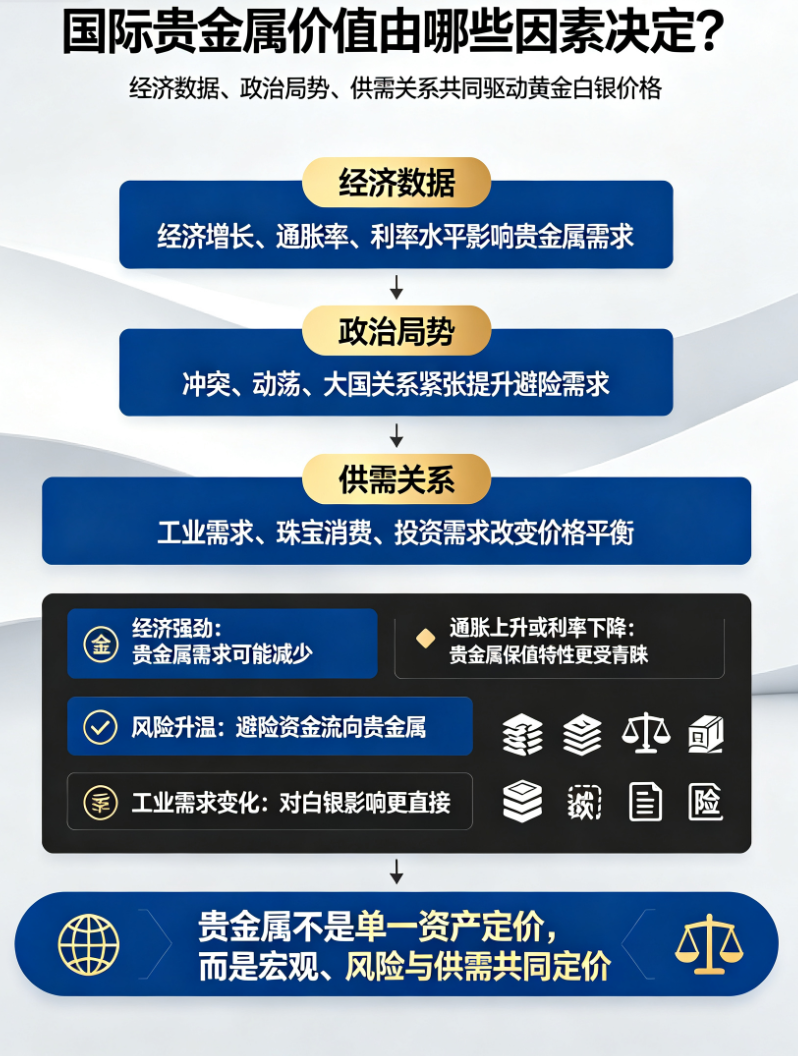
The code of precious metal value fluctuations lies in the complex interplay of macroeconomic data, political and geopolitical situations, supply-demand relationships, and market psychology. The cycle shifts of the global economy, central bank monetary policy choices, eruption and evolution of geopolitical conflicts, and ebb and flow of investor sentiment jointly shape the persistently fluctuating price trajectories of gold, silver, and other precious metals.
For investors, understanding the interaction mechanisms among these variables and identifying the core contradictions at each period are prerequisites for making correct investment decisions. In an era of uncertainty, the charm of precious metals lies not only in their value storage function spanning millennia but also in offering investors a unique window to observe and respond to global changes. Whether as a tool for asset allocation or as an entry point for understanding global economic logic, the knowledge system of precious metal investment is one of the core competencies indispensable for modern investors.
Looking ahead, with profound adjustments in the global political and economic landscape, the evolution of de-dollarization trends, and resource constraints brought by climate change, the strategic value of precious metals is likely to be further highlighted. Investors who deeply understand their fluctuation patterns and flexibly use investment tools will be able to build more robust wealth fortresses in a complex and ever-changing market environment.