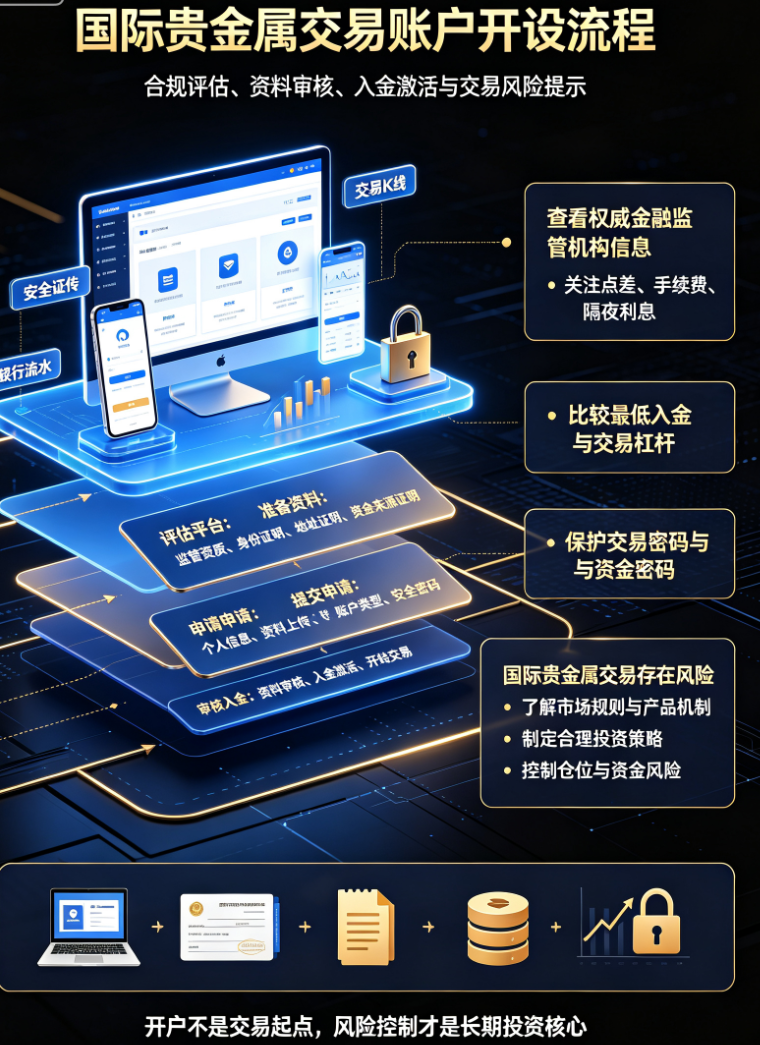
International Precious Metals Trading Account Opening Guide: From Platform Selection to Funding
Keywords
International Precious Metals Trading, Trading Platform Selection, Account Opening Process, Risk Management, Investment Strategy
Introduction: Precious Metals Trading – An Everlasting Global Investment Hotspot
On the global economic stage, precious metals trading has always attracted significant attention. Whether it's gold's deep historical role as a safe-haven asset or silver's unique balance between industrial and financial properties, precious metals remain an indispensable part of international investment portfolios. In recent years, rising global economic uncertainty, geopolitical risks, and persistent inflationary pressures have driven more investors towards the precious metals market, seeking wealth preservation and growth through this traditional yet efficient asset class.
However, for investors looking to engage in international precious metals trading, opening a suitable trading account is not a simple form-filling process but the starting point of a series of thoughtful decisions. From selecting a compliant platform to preparing account documents and funding the account, each step affects security, efficiency, and potential returns. This article systematically walks you through the entire process of opening an international precious metals trading account, incorporating market practices and risk control principles to help you start your precious metals investment journey steadily.
1. Overview of Global Precious Metals Market and Investment Logic
1.1 Core Characteristics of the Precious Metals Market
The international precious metals trading market is one of the largest and most liquid financial derivative markets globally. For gold, the London Bullion Market (LBMA), New York Commodities Exchange (COMEX), and Zurich Gold Market form the three pillars of global gold pricing. Precious metals trading attracts global investors mainly due to the following core characteristics:
- Safe-Haven Attributes: During financial market turmoil, precious metals, especially gold, often become a haven for capital
- Inflation Hedge: Over the long term, precious metal prices show a positive correlation with inflation
- High Liquidity: 24-hour global trading provides outstanding convenience
- Leverage Effect: International precious metals trading typically offers leverage, amplifying investment return potential
1.2 Why Investors Choose International Precious Metals Trading
Compared to domestic precious metals markets, international trading offers a wider range of investment options, more flexible trading mechanisms, and more comprehensive risk management tools. Investors can participate through contracts for difference (CFDs), futures, spot trading, and more, while benefiting from quotes and liquidity support from top global financial institutions.
However, this openness and flexibility also come with higher requirements: investors must be able to identify legitimate platforms, deeply understand trading rules, and cultivate mature risk management awareness.
2. Trading Platform Selection and Evaluation: Compliance and Reputation as Cornerstones
2.1 Regulatory Qualifications: The "Gold Standard" for Identifying Legitimate Platforms
First, it is crucial to select a compliant and reputable trading platform. In international finance, different regulatory bodies vary significantly in authority and strictness. Investors can assess platform reliability through the following aspects:
- Regulatory Qualifications: Check if the platform is regulated by authoritative financial regulators such as the UK Financial Conduct Authority (FCA), US Commodity Futures Trading Commission (CFTC), Australian Securities and Investments Commission (ASIC), Cyprus Securities and Exchange Commission (CySEC), etc.
- FCA Regulation: Considered one of the strictest regulatory systems globally, requiring platforms to adhere to client fund segregation, regular reporting, and investor protection rules.
- CFTC Regulation: The governing body for US futures markets, imposing clear limits on leverage, margin, and trading conduct.
- ASIC Regulation: A major regulator in the Asia-Pacific region, also enforcing client fund segregation requirements.
Investors should be particularly cautious of platforms holding only offshore licenses (e.g., Belize, Seychelles), which have looser regulatory environments and limited investor protection.
2.2 Platform Reputation and Trading Cost Analysis
-
Platform Reputation: Research other investors' reviews and feedback on financial forums and social media. Focus on withdrawal efficiency, customer service quality, and complaint handling. Check independent rating sites like Trustpilot and Forex Peace Army for genuine user feedback.
-
Trading Costs: Including spreads, commissions, overnight interest, etc., all impact investment returns. Spreads are the bid-ask difference, the main source of platform revenue. For precious metals like gold, spreads are usually quoted in "USD/ounce." Some platforms offer fixed spreads, others floating spreads. Investors should choose a cost structure that suits their trading frequency and holding period.
-
Platform Technical Stability: Does the platform support mainstream trading software like MT4/MT5? What is server response speed? Are risk management tools like stop-loss, take-profit, and trailing stop provided? These technical details directly affect trade execution quality.
2.3 Leverage and Account Type Selection
Different account types may have varying minimum deposit requirements, trading leverage, and services. For example, a standard account might offer 1:100 leverage, while professional or VIP accounts may offer higher leverage (e.g., 1:200 or 1:400). However, note that high leverage amplifies both gains and losses. Investors should carefully choose leverage ratios based on their risk tolerance and experience.
3. Account Opening Document Preparation and Process Breakdown
3.1 Required Documents and Precautions
Next, prepare the documents needed for account opening. Typically include the following:
-
Identity Proof: Scanned copies of valid ID cards, passports, etc. Ensure documents are within validity and scans are clear. For non-residents, passports are the most common identity document.
-
Address Proof: Utility bills, bank statements, etc., proving your residential address. The name on the address proof must match the identity proof, and the document date should be within 3 months. If using electronic statements, ensure they include the issuer's name and your full address.
-
Proof of Funds Source: May require bank statements, pay slips, etc., to prove the legality of your funds. Some platforms may request recent pay slips, tax documents, or bank account statements for anti-money laundering compliance checks.
Professional Tip: Before submitting documents, save them in PDF or JPEG format within the platform's size limits. Also, obscure sensitive information (e.g., parts of the ID number) while retaining enough identifiable data.
3.2 Account Opening Process Step-by-Step
Once documents are ready, start the account opening process on the chosen trading platform:
-
Visit the platform's official website and find the account opening entry. Usually prominently placed on the homepage, labeled "Open Real Account" or "Register Trading Account."
-
Fill in personal information, including name, contact details, email, etc. Use real information to pass the platform's KYC (Know Your Customer) verification.
-
Upload the prepared account opening documents. The system provides an upload interface with guidance to ensure files meet format and size requirements.
-
Select an account type. Common types include:
- Standard Account: Suitable for most investors with moderate trading costs
- Micro Account: For starting with small funds or testing strategies
- Islamic Account: Interest-free account compliant with Sharia law
- Professional/ECN Account: For high-frequency traders or large capital investors
-
Set trading password and fund password, ensuring password security. Use complex combinations and differentiate between trading and fund operation passwords to enhance account security.
-
Agree to the platform's agreement and risk disclosure. This is a critical step. Investors should carefully read the terms, understanding trading rules, risk warnings, fee descriptions, and dispute resolution mechanisms.
3.3 Review and Activation
After submitting the account opening application, the platform will review your documents. Review time is usually between 24 to 48 hours, some platforms may be faster. Upon approval, you'll be notified via email or SMS. Then you need to make a deposit to activate the account and start trading.
4. Risk Assessment and Management Strategies: Full Protection from Account Opening to Trading
4.1 Main Risks of International Precious Metals Trading
It must be emphasized that international precious metals trading carries certain risks. These risks are not limited to the trading process; from the account opening stage, investors need to establish risk awareness:
- Market Volatility Risk: Precious metal prices are influenced by exchange rates, geopolitics, central bank policies, supply-demand dynamics, etc., leading to sharp fluctuations
- Leverage Risk: High leverage can lead to margin calls or even losses exceeding initial investment
- Liquidity Risk: Although overall market liquidity is high, slippage may occur during extreme market conditions
- Platform Risk: Choosing non-compliant platforms may compromise fund security or withdrawal ease
- Operational Risk: The investor's own technical errors, emotional control issues, or strategy flaws
4.2 Formulating a Sound Investment Strategy
Before opening an account and trading, investors should fully understand market rules and risks, and formulate a reasonable investment strategy. A complete risk management system should include:
- Money Management: Set risk exposure per trade at 1%-3% of total capital
- Stop-Loss Setting: Always set a stop-loss for each position to prevent loss expansion
- Position Sizing: Avoid heavy or full positions; maintain capital flexibility
- Trading Discipline: Strictly follow the plan; do not chase or panic sell
- Continuous Learning: Monitor macroeconomic data, technical analysis methods, and market sentiment indicators
4.3 Demo Account and Market Simulation Training
For novice investors, it is strongly recommended to first open a demo account on the platform for practice. Demo accounts typically provide virtual funds and real market environments, allowing investors to familiarize themselves with platform operations, test trading strategies, and experience market volatility with zero risk. It is generally advised to run demo trading for at least 3 months and record enough trade cases before considering switching to a real account.
5. Summary and Action Suggestions
5.1 Key Points Recap
The first step in international precious metals trading is selecting a compliant and reputable platform. Investors should conduct a comprehensive assessment from regulatory qualifications, reputation, trading costs, and technical stability. Preparation of account documents must ensure authenticity, completeness, and compliance. Although the account opening process seems simple, each step should be carefully checked to avoid document inconsistencies that cause review delays.
After account opening and funding, investors should adopt a long-term investment perspective, abandoning the mindset of "getting rich overnight." The essence of precious metals trading is asset allocation and risk management, not short-term speculation. Through continuous learning, disciplined execution, and risk control, investors can better utilize the precious metals market for wealth preservation and growth.
5.2 Suggested Action Steps
- Define investment goals and risk tolerance
- Select 2-3 platforms that meet regulatory requirements and have good reputations for comparison
- Open a demo account and practice for at least 2 months
- Prepare real account documents and complete account opening
- First deposit controlled at a low amount (e.g., minimum deposit requirement)
- Start practicing trading strategies with small funds
- Consistently maintain a trading journal and periodically review and adjust
Conclusion: The path of precious metals investment is like sailing the sea, requiring a clear direction, a reliable vessel, and a sober captain. Account opening is just the starting point; the real challenges and opportunities lie in continuous learning, practice, and self-improvement. May this article serve as a practical guide to the world of international precious metals trading, helping you invest wisely and move forward steadily within a compliant and secure framework.